> ## Documentation Index
> Fetch the complete documentation index at: https://docs.rubixkube.ai/llms.txt
> Use this file to discover all available pages before exploring further.
# The Kepler workspace
> A tour of the Kepler window: the sidebar, the chat, and the Terminal, Browser, Editor, Memory, Feed and Topology panels. Learn the shortcuts and how workspaces and sessions fit together.
Kepler is one window with three parts: a sidebar on the left, the chat in the middle, and panels you open beside it. The panels are shared. What you see in the Terminal, Browser and Editor is what Kepler sees, and Kepler can act in them too.
Shortcuts on this page are written for macOS. On Windows and Linux, use `Ctrl` where you see `Cmd`.
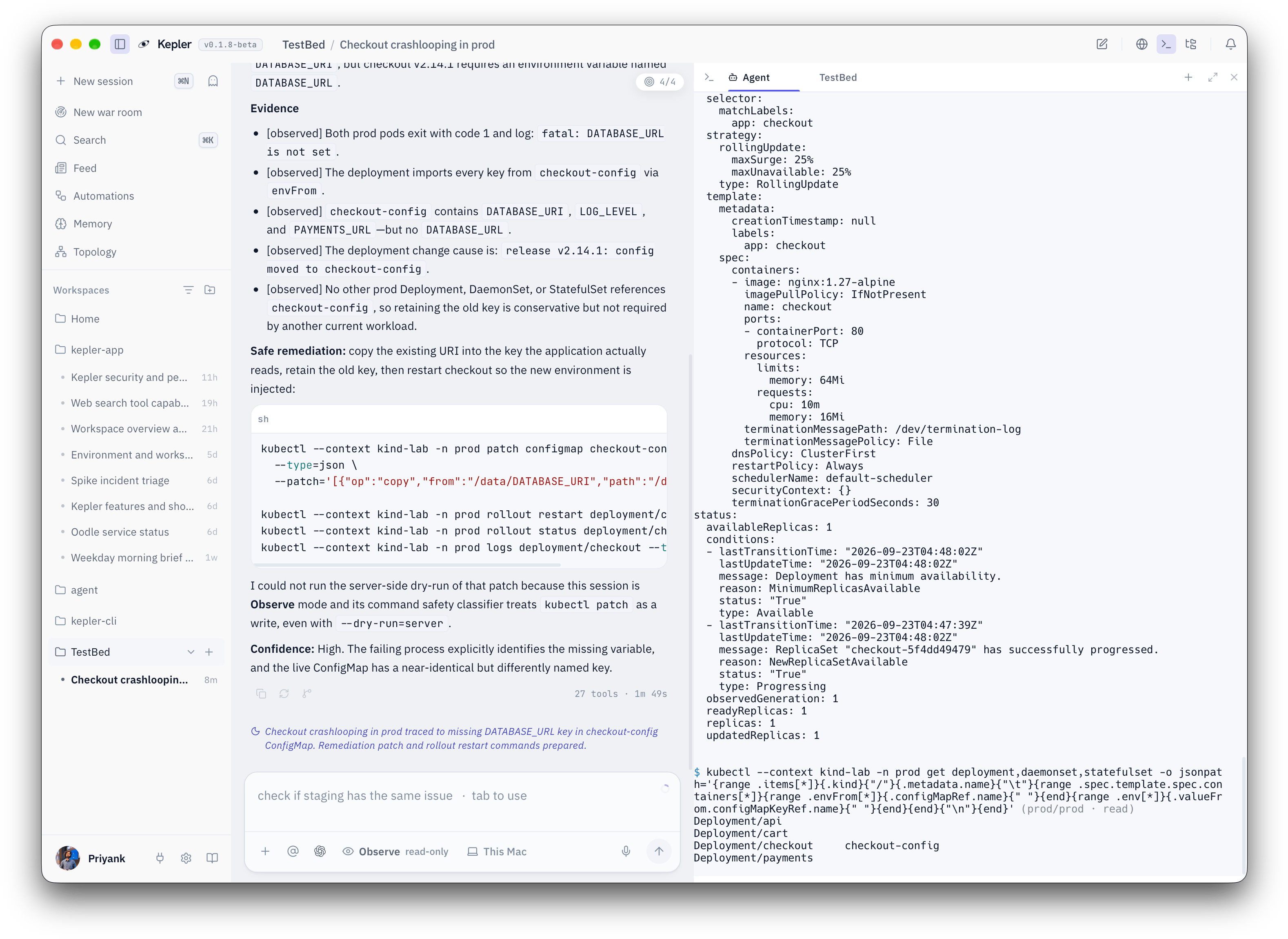 Sidebar, chat, and one panel open. Every panel can be toggled with a shortcut.
## The sidebar
Toggle the sidebar with `Cmd+\`. From top to bottom it holds:
| Item | What it does |
| ------------------------- | ------------------------------------------------------------------------------------------------------------------------------------------------------------ |
| **Workspaces** | The folders Kepler can read. Open one with `Cmd+O`. |
| **Sessions** | Your conversations, grouped by workspace, flat, or by time (Today, Yesterday, Previous 7 days, Older). Sort by recent or alphabetical. |
| **New session** | Starts a fresh conversation (`Cmd+N`). |
| **New incognito session** | A session that reads and writes no memory. See [Sessions](#sessions-and-incognito-sessions). |
| **New war room** | Opens an incident room where Kepler leads a team of agents. See [War room](/kepler/war-room). |
| **Search** | Searches sessions, messages, workspaces and settings (`Cmd+K`). |
| **Feed** | Everything Kepler produced while you were elsewhere: briefs, finished documents, and the workflows behind them. A **Waiting** tab holds items that need you. |
| **Memory** | What Kepler remembers about your systems (`Cmd+M`). |
| **Topology** | The map of clusters, hosts and accounts Kepler has found on your machine. |
Right-click a session to pin, rename, export or delete it. Double-click its title to rename it in place.
## The chat
The chat is where you talk to Kepler. Type anywhere in the window and the text goes to the composer. `Enter` sends, `Shift+Enter` adds a line. Type `/` for commands and `@` to attach context.
While Kepler works you see its thinking, a card for each tool it runs, and the exact command it ran. Type while a run is in progress and the message is queued and sent as its own turn when the run ends. Press `Esc` to stop a run.
A few things dock above the composer when they need you:
* **Posture chip**: the autonomy dial. Click it or press `Shift+Tab` to cycle Observe, Assist and Yolo. See [Postures](/kepler/postures).
* **Model picker**: which model this conversation uses. Open it from the composer or with `/model`. Kepler never switches models on its own.
* **Approval dock**: the command Kepler wants to run, with Run, Reject, and two ways to stop being asked again: **This session** for this conversation, **Always** for every conversation from now on. `Cmd+Enter` runs, `Cmd+Shift+Enter` allows for the session, `Esc` rejects.
* **Clarification card**: when Kepler hits a real fork it asks instead of guessing.
* **Todo tracker**: the steps of a longer task, ticked off as Kepler goes.
* **Machine control**: beside Send, once Remote access is on. It names the machine this thread's commands and files run on, **This Mac** until you pick another. See [Remote access](/kepler/remote-access).
The small indicator at the top right of the conversation opens **This thread**: the task list for the current job, the watchers armed in this session, and the folders Kepler can reach here.
### Operator shell mode
Type `!` at the start of an empty composer and it turns into a shell prompt. The command you type runs in your terminal, and Kepler reads the output on your next message. This works in every posture, Observe included, because you are the one running the command. The [always-blocked list](/kepler/permissions#always-blocked) still applies. Press `Esc` to leave shell mode.
```
! kubectl get pods -n checkout
```
## Panels
Each panel opens beside the chat with a shortcut. Press the shortcut again to close it.
| Panel | Shortcut | What it is for |
| -------- | -------- | ----------------------------------------------------------------------------------------- |
| Terminal | `Cmd+J` | A real shell. Kepler runs its commands in an **Agent** tab so you watch exactly what ran. |
| Browser | `Cmd+B` | A browser Kepler can read and drive. Dashboards, consoles, docs. |
| Editor | `Cmd+E` | A file tree and code editor over the folders you granted. |
| Memory | `Cmd+M` | Graph, Pages and Artifacts tabs over what Kepler remembers. |
| Settings | `Cmd+,` | Every setting. See [Settings](/kepler/settings). |
Feed and Topology open from the sidebar.
### Terminal
The Terminal is your shell, not an emulation. Open more shells with **New shell** in the tab strip. Copy with `Cmd+C` and paste with `Cmd+V` (`Ctrl+Shift+C` and `Ctrl+Shift+V` on Windows and Linux).
Every command you run gets a dot in the gutter: hollow while it runs, green when it exits 0, red otherwise. Click a command in the scrollback (its dot, or right-click anywhere in its output) and pick **Add to chat** to send the command and its output into the conversation. That is the fastest way to hand Kepler something you already ran.
### Browser
The Browser panel has tabs and an address bar. Paste a dashboard URL into the chat, or ask Kepler to open one, and it navigates, reads the page, clicks and scrolls. A banner above the page says **Kepler is browsing** while it drives. Click **Take control** to use the page yourself, then **Give back to Kepler** when you are done.
Log into a dashboard once in the panel and Kepler can read that dashboard from then on. A Grafana board or a cloud console you are signed into stays readable across sessions.
```
Open the checkout latency dashboard in Grafana and tell me what p99 did in the last hour.
```
### Editor and file explorer
`Cmd+E`, or the Explorer button in the top bar, opens a file tree and an editor. The tree only shows folders in the current workspace. Pick a file to open it. Files too large to load whole open read-only. Ask Kepler to change a file and it shows the diff and asks before writing, in any posture that allows writes.
### Memory, Feed and Topology
The Memory panel (`Cmd+M`) shows what Kepler has learned, in three tabs: **Graph**, **Pages** and **Artifacts**. The Feed lists activity and, under **Waiting**, anything that needs an answer from you. Topology shows the clusters, hosts and accounts Kepler found from your local config, with drafts you approve or reject before they join the map. See [Memory](/kepler/memory) for how to edit what Kepler remembers.
### Center stage
Double-click a panel's header to move it to the middle of the window, where the chat usually sits. Use it when you want a full-width terminal or browser. Press `Esc`, or click **Back to the side**, to return the chat to the center.
Sidebar, chat, and one panel open. Every panel can be toggled with a shortcut.
## The sidebar
Toggle the sidebar with `Cmd+\`. From top to bottom it holds:
| Item | What it does |
| ------------------------- | ------------------------------------------------------------------------------------------------------------------------------------------------------------ |
| **Workspaces** | The folders Kepler can read. Open one with `Cmd+O`. |
| **Sessions** | Your conversations, grouped by workspace, flat, or by time (Today, Yesterday, Previous 7 days, Older). Sort by recent or alphabetical. |
| **New session** | Starts a fresh conversation (`Cmd+N`). |
| **New incognito session** | A session that reads and writes no memory. See [Sessions](#sessions-and-incognito-sessions). |
| **New war room** | Opens an incident room where Kepler leads a team of agents. See [War room](/kepler/war-room). |
| **Search** | Searches sessions, messages, workspaces and settings (`Cmd+K`). |
| **Feed** | Everything Kepler produced while you were elsewhere: briefs, finished documents, and the workflows behind them. A **Waiting** tab holds items that need you. |
| **Memory** | What Kepler remembers about your systems (`Cmd+M`). |
| **Topology** | The map of clusters, hosts and accounts Kepler has found on your machine. |
Right-click a session to pin, rename, export or delete it. Double-click its title to rename it in place.
## The chat
The chat is where you talk to Kepler. Type anywhere in the window and the text goes to the composer. `Enter` sends, `Shift+Enter` adds a line. Type `/` for commands and `@` to attach context.
While Kepler works you see its thinking, a card for each tool it runs, and the exact command it ran. Type while a run is in progress and the message is queued and sent as its own turn when the run ends. Press `Esc` to stop a run.
A few things dock above the composer when they need you:
* **Posture chip**: the autonomy dial. Click it or press `Shift+Tab` to cycle Observe, Assist and Yolo. See [Postures](/kepler/postures).
* **Model picker**: which model this conversation uses. Open it from the composer or with `/model`. Kepler never switches models on its own.
* **Approval dock**: the command Kepler wants to run, with Run, Reject, and two ways to stop being asked again: **This session** for this conversation, **Always** for every conversation from now on. `Cmd+Enter` runs, `Cmd+Shift+Enter` allows for the session, `Esc` rejects.
* **Clarification card**: when Kepler hits a real fork it asks instead of guessing.
* **Todo tracker**: the steps of a longer task, ticked off as Kepler goes.
* **Machine control**: beside Send, once Remote access is on. It names the machine this thread's commands and files run on, **This Mac** until you pick another. See [Remote access](/kepler/remote-access).
The small indicator at the top right of the conversation opens **This thread**: the task list for the current job, the watchers armed in this session, and the folders Kepler can reach here.
### Operator shell mode
Type `!` at the start of an empty composer and it turns into a shell prompt. The command you type runs in your terminal, and Kepler reads the output on your next message. This works in every posture, Observe included, because you are the one running the command. The [always-blocked list](/kepler/permissions#always-blocked) still applies. Press `Esc` to leave shell mode.
```
! kubectl get pods -n checkout
```
## Panels
Each panel opens beside the chat with a shortcut. Press the shortcut again to close it.
| Panel | Shortcut | What it is for |
| -------- | -------- | ----------------------------------------------------------------------------------------- |
| Terminal | `Cmd+J` | A real shell. Kepler runs its commands in an **Agent** tab so you watch exactly what ran. |
| Browser | `Cmd+B` | A browser Kepler can read and drive. Dashboards, consoles, docs. |
| Editor | `Cmd+E` | A file tree and code editor over the folders you granted. |
| Memory | `Cmd+M` | Graph, Pages and Artifacts tabs over what Kepler remembers. |
| Settings | `Cmd+,` | Every setting. See [Settings](/kepler/settings). |
Feed and Topology open from the sidebar.
### Terminal
The Terminal is your shell, not an emulation. Open more shells with **New shell** in the tab strip. Copy with `Cmd+C` and paste with `Cmd+V` (`Ctrl+Shift+C` and `Ctrl+Shift+V` on Windows and Linux).
Every command you run gets a dot in the gutter: hollow while it runs, green when it exits 0, red otherwise. Click a command in the scrollback (its dot, or right-click anywhere in its output) and pick **Add to chat** to send the command and its output into the conversation. That is the fastest way to hand Kepler something you already ran.
### Browser
The Browser panel has tabs and an address bar. Paste a dashboard URL into the chat, or ask Kepler to open one, and it navigates, reads the page, clicks and scrolls. A banner above the page says **Kepler is browsing** while it drives. Click **Take control** to use the page yourself, then **Give back to Kepler** when you are done.
Log into a dashboard once in the panel and Kepler can read that dashboard from then on. A Grafana board or a cloud console you are signed into stays readable across sessions.
```
Open the checkout latency dashboard in Grafana and tell me what p99 did in the last hour.
```
### Editor and file explorer
`Cmd+E`, or the Explorer button in the top bar, opens a file tree and an editor. The tree only shows folders in the current workspace. Pick a file to open it. Files too large to load whole open read-only. Ask Kepler to change a file and it shows the diff and asks before writing, in any posture that allows writes.
### Memory, Feed and Topology
The Memory panel (`Cmd+M`) shows what Kepler has learned, in three tabs: **Graph**, **Pages** and **Artifacts**. The Feed lists activity and, under **Waiting**, anything that needs an answer from you. Topology shows the clusters, hosts and accounts Kepler found from your local config, with drafts you approve or reject before they join the map. See [Memory](/kepler/memory) for how to edit what Kepler remembers.
### Center stage
Double-click a panel's header to move it to the middle of the window, where the chat usually sits. Use it when you want a full-width terminal or browser. Press `Esc`, or click **Back to the side**, to return the chat to the center.
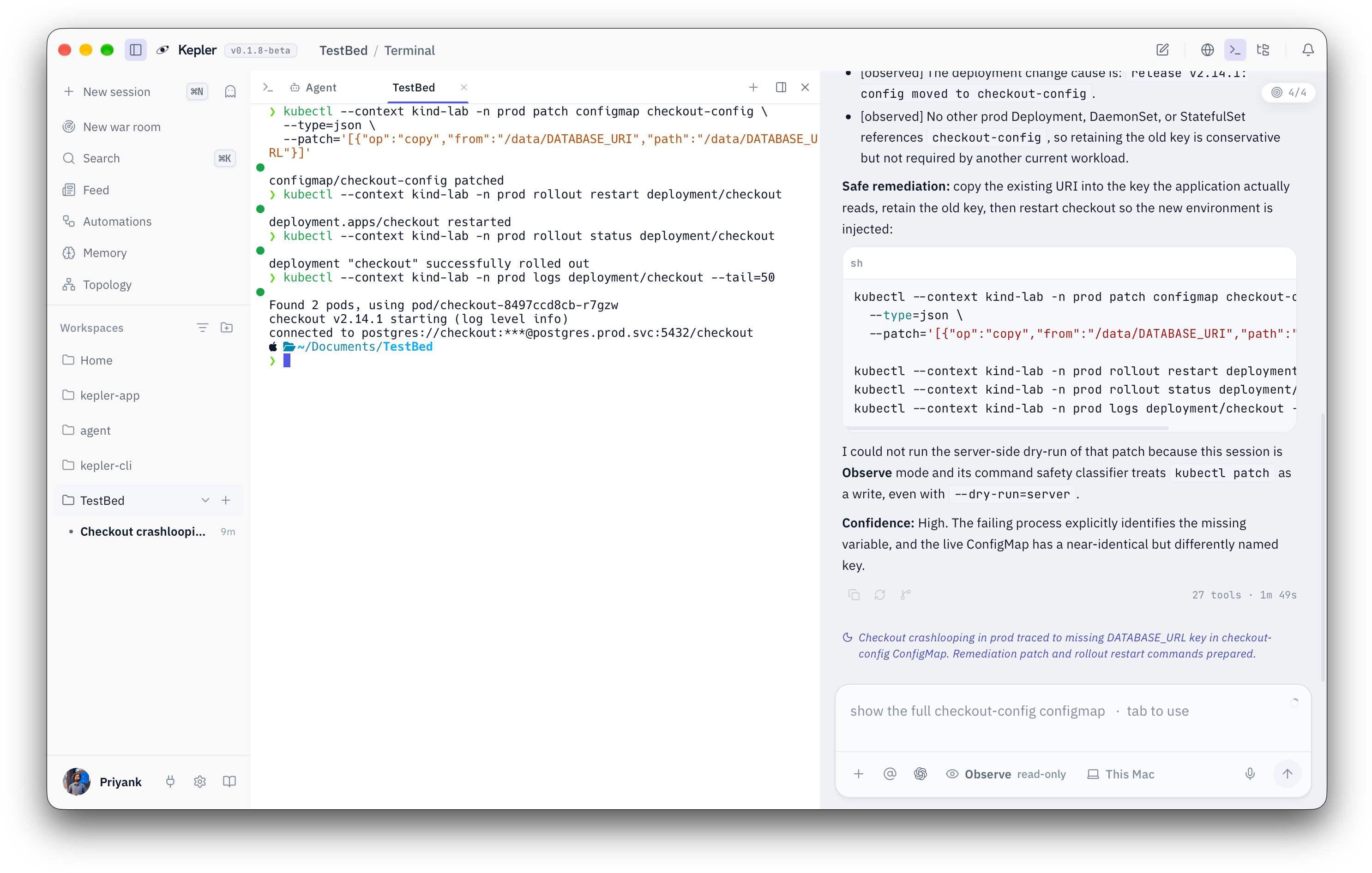 The Terminal at center stage, with the chat moved to the side. Here the operator ran the fix Kepler proposed, including the rollout restart Kepler itself may never run. Esc gives the center back.
## Workspaces
A workspace is the set of folders Kepler is allowed to read and edit. Nothing outside it is visible to Kepler, not in the Editor, not through file tools, and not through a shell command that names a path outside it. That fence is the reason Kepler can be trusted with a terminal: it can only reach what you handed it.
To add a folder:
Press `Cmd+O`, or click **Open workspace** in the sidebar, and pick a folder. That folder becomes a workspace.
Click the workspace in the sidebar to open its settings and use **Add folder**, or type `/workspace add ` in the chat. `/workspace remove ` takes one away.
If Kepler needs a path you have not granted, it stops and asks, in every posture. The card offers to grant the enclosing folder for the session.
Each workspace can carry its own `kepler.md` with conventions for that project. Run `/init` to draft one. See [Memory](/kepler/memory).
## Sessions and incognito sessions
A session is one conversation. It keeps its own posture, model, and history, and it belongs to a workspace. Start a new one with `Cmd+N` or `/new`. Come back to an older one and a short recap of where the work stands waits at the tail of the thread. Everything Kepler learns in a session, such as a service name, an incident, or a preference, goes into memory for later.
An incognito session is the exception. Start one from the ghost button next to **New session**. It reads no memory, writes no memory, and nothing said in it is learned. Use it for a one-off question you do not want to shape future answers, or for anything you would rather Kepler forget. You can turn incognito off for a session from its right-click menu, but you cannot turn it on after the fact.
## Where to go next
Observe, Assist and Yolo, and what each one asks you about.
Every slash command and keyboard shortcut.
What Kepler remembers and how to edit it.
Run an incident with a team of agents.
The Terminal at center stage, with the chat moved to the side. Here the operator ran the fix Kepler proposed, including the rollout restart Kepler itself may never run. Esc gives the center back.
## Workspaces
A workspace is the set of folders Kepler is allowed to read and edit. Nothing outside it is visible to Kepler, not in the Editor, not through file tools, and not through a shell command that names a path outside it. That fence is the reason Kepler can be trusted with a terminal: it can only reach what you handed it.
To add a folder:
Press `Cmd+O`, or click **Open workspace** in the sidebar, and pick a folder. That folder becomes a workspace.
Click the workspace in the sidebar to open its settings and use **Add folder**, or type `/workspace add ` in the chat. `/workspace remove ` takes one away.
If Kepler needs a path you have not granted, it stops and asks, in every posture. The card offers to grant the enclosing folder for the session.
Each workspace can carry its own `kepler.md` with conventions for that project. Run `/init` to draft one. See [Memory](/kepler/memory).
## Sessions and incognito sessions
A session is one conversation. It keeps its own posture, model, and history, and it belongs to a workspace. Start a new one with `Cmd+N` or `/new`. Come back to an older one and a short recap of where the work stands waits at the tail of the thread. Everything Kepler learns in a session, such as a service name, an incident, or a preference, goes into memory for later.
An incognito session is the exception. Start one from the ghost button next to **New session**. It reads no memory, writes no memory, and nothing said in it is learned. Use it for a one-off question you do not want to shape future answers, or for anything you would rather Kepler forget. You can turn incognito off for a session from its right-click menu, but you cannot turn it on after the fact.
## Where to go next
Observe, Assist and Yolo, and what each one asks you about.
Every slash command and keyboard shortcut.
What Kepler remembers and how to edit it.
Run an incident with a team of agents.